• About Us
    • Our Purpose
    • Our Strategy
    • What we do
    • Our Impact
    • Our team
    • Work For Us
    • Volunteer
    • The DMD Registry
    • Action Duchenne Policies
  • Get Support
    • Support Calendar – What’s On
    • In-Person Support Events
    • Register for Support
      • Time Out – A Space for Mums
      • Dads Against Duchenne
      • Grandparents Together
      • Open Space
      • Group Counselling Programme
    • Recently diagnosed
    • Schools
    • Siblings
    • End of Life and Bereavement
  • AD Annual International Conference
    • Highlights from the Action Duchenne Conference 2025
    • Action Duchenne Annual International Conference 2025
  • News, Webinars and Blogs
    • News
    • Webinar Series 2026
    • Webinar recordings
    • Bite-Sized Duchenne Science Live
      • Facts about Duchenne muscular dystrophy
      • Signs and Symptoms of Duchenne Muscular Dystrophy
      • Diagnosis of Duchenne Muscular Dystrophy
      • Crucial Genetic Terminology
      • Genetics – Blueprint of Duchenne Muscular Dystrophy
      • How is Duchenne Muscular Dystrophy Inherited?
    • Hear From Our Community
  • Support Us
  •  0 items - £0.00
  • Menu
  • Skip to right header navigation
  • Skip to main content
  • Skip to secondary navigation
  • Skip to primary sidebar
  • Skip to footer

Before Header

  • My account
  •  0 items - £0.00

Action Duchenne

Header Right

  • About Us
    • Our Purpose
    • Our Strategy
    • What we do
    • Our Impact
    • Our team
    • Work For Us
    • Volunteer
    • The DMD Registry
    • Action Duchenne Policies
  • Get Support
    • Support Calendar – What’s On
    • In-Person Support Events
    • Register for Support
      • Time Out – A Space for Mums
      • Dads Against Duchenne
      • Grandparents Together
      • Open Space
      • Group Counselling Programme
    • Recently diagnosed
    • Schools
    • Siblings
    • End of Life and Bereavement
  • AD Annual International Conference
    • Highlights from the Action Duchenne Conference 2025
    • Action Duchenne Annual International Conference 2025
  • News, Webinars and Blogs
    • News
    • Webinar Series 2026
    • Webinar recordings
    • Bite-Sized Duchenne Science Live
      • Facts about Duchenne muscular dystrophy
      • Signs and Symptoms of Duchenne Muscular Dystrophy
      • Diagnosis of Duchenne Muscular Dystrophy
      • Crucial Genetic Terminology
      • Genetics – Blueprint of Duchenne Muscular Dystrophy
      • How is Duchenne Muscular Dystrophy Inherited?
    • Hear From Our Community
  • Support Us
You are here: Home / News / Brain Involvement  in Dystrophinopathies (BIND) Study
Brain Involvement  in Dystrophinopathies (BIND) Study

Brain Involvement  in Dystrophinopathies (BIND) Study

October 8, 2021 by Lizzie Cox

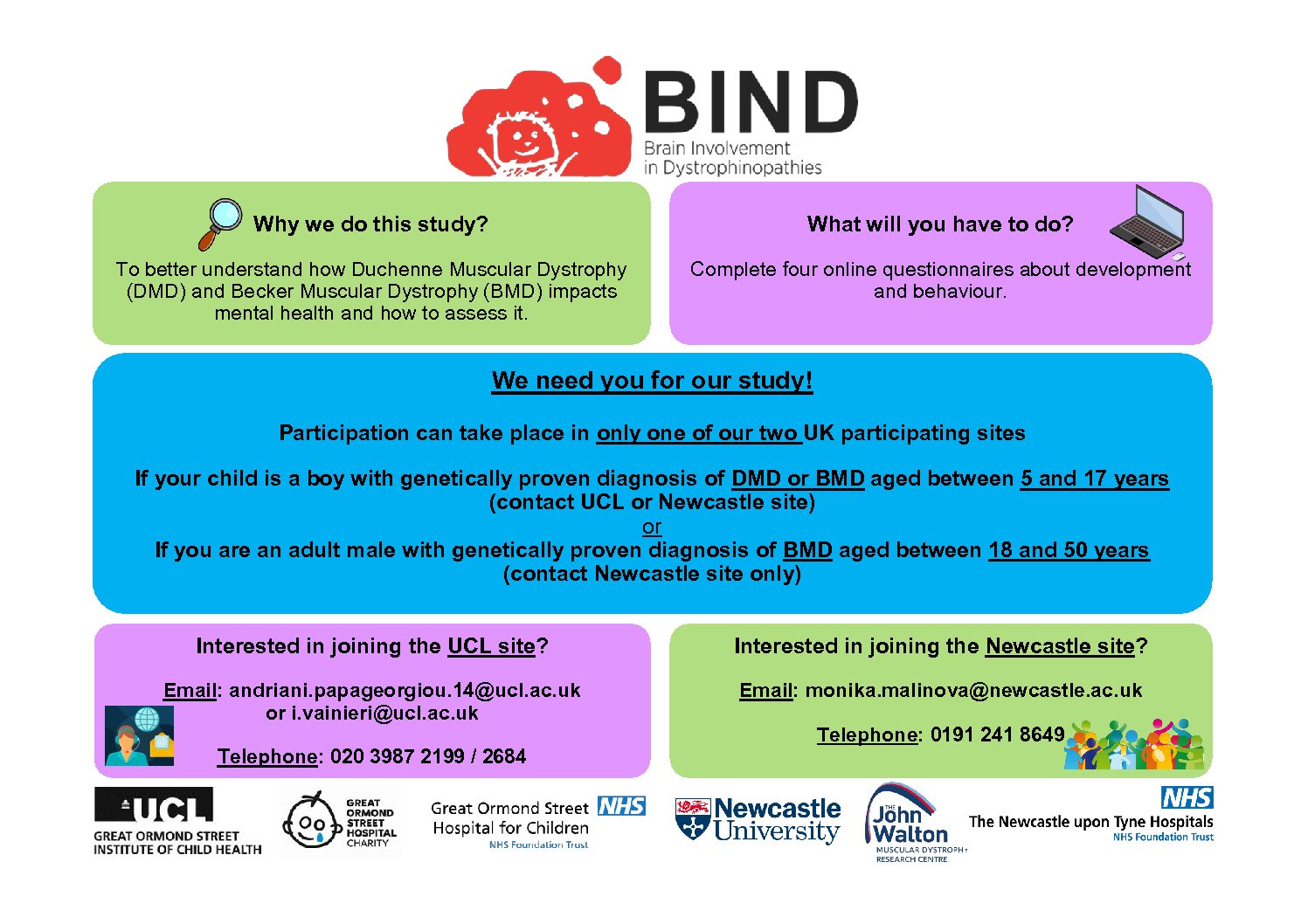
BIND is a large-scale study involving six European countries (Denmark, France, Italy, Spain, The Netherlands, UK), with the aim of assessing the association between dystrophin isoforms and certain behaviours in patients with Duchenne Muscular Dystrophy (DMD) and Becker Muscular Dystrophy (BMD). The UCL Great Ormond Street Institute of Child Health and the Newcastle upon Tyne Hospitals NHS Foundation Trust, along with 19 partners from Europe and Japan, are conducting a study which will look into the brain involvement in dystrophinopathies.

They are looking for boys with DMD and BMD aged 5 – 17 years and BMD patients aged 18 – 50 years to take part. The study will include completing a set of online questionnaires about the participants’ behaviour, learning, well-being and relationships. These are estimated to take up to 70 minutes, however they can be completed in multiple sittings. Depending on the timeline of Covid-19 restrictions being lifted, the next step of this study is to invite a subgroup of these participants to attend a clinic appointment where further cognitive assessments will be performed.

Recruitment in the UK will take place in two sites; UCL Great Ormond Street Institute of Child Health and Newcastle University. The UCL site will be recruiting only children with DMD and BMD, while the Newcastle site will be recruiting both children with DMD and BMD, as well as adults with BMD. Participants will have a choice regarding which site is most suitable for them.

Project Goals

The BIND project’s ambition is to elucidate the role of dystrophin in the brain. This protein is deficient in DMD and only partly functional in BMD. The project aims to develop new outcome measures that could inform the field for future clinical trials and will promote more rigorous assessment and intervention of brain comorbidities. The ultimate goal of this project is to improve understanding and measurement of dystrophin in the brain, thus working towards better treatments, care and outcomes for all those living with DMD and BMD.

Objective goals:

  • Localising the isoforms that the DMD locus produces in the brain and their function;
  • Improve understanding of postnatal brain restoration of the different dystrophin isoforms using preclinical models;
  • Defining the spectrum of brain comorbidities in DMD and BMD individuals, and how to best assess them;
  • Creating optimal and uniform outcome measures to assess brain comorbidities in DMD and BMD.

Contact Information

If you wish to have further information about this study, or if you know a young person or family who may be interested please contact:

  • UCL team by emailing either Andria Papageorgiou (andriani.papageorgiou.14@ucl.ac.uk) or Isabella Vainieri (i.vainieri@ucl.ac.uk) or
  • Newcastle team by emailing Monika Malinova (monika.malinova@newcastle.ac.uk)

Further information:

This project has received funding from the European Union’s Horizon 2020 research and innovation programme under grant agreement No 847826.

Additional reading

  • Get help and support
  • Research we are funding
Share this:

Category: News

Previous Post: « Sam’s Conference blog
Next Post: LEGO Quest 2021 »

Primary Sidebar

From our community

Blue Monday Blog: Hear from Victoria, our Fundraising Officer and Duchenne Mum

Written by Victoria Edwards, Action Duchenne’s Fundraising Officer and mum to Dougie (who lives with Duchenne) and Allie. Feeling Blue “This Monday was Blue Monday, and wow… I really felt it. It was grey, drizzly, my son was up half the night and ended up off school from sheer tiredness. My daughter went in to …

“Making contact with Action Duchenne provided a lifeline”

“Making contact with Action Duchenne provided a lifeline”: Find out why Ben Dolling decided to run the London Marathon dressed as a parrot! Harry was diagnosed with Duchenne muscular dystrophy in 2019 Ben and his wife have 3 children: a daughter in year 3 and a son in his first year of university and Harry, …

The Power of Shared Experience: “Honestly, it would’ve been a much harder road without having joined this group.”   

Action Duchenne have monthly online meet-ups for Duchenne dads, mums and grandparents, facilitated by our Family Support Officers and designed to enable connection with those who truly understand. A Duchenne diagnosis can often set people apart from the support systems they usually rely on. Our support groups mean you can meet people who know exactly …

Footer

Action Duchenne
5th Floor, Mariner House
62 Prince Street
Bristol
BS1 4QD

07535 498 506
info@actionduchenne.org 


Subscribe to our mailing list

Do you consent to receiving regular email updates? *
Email Format
  • Accessibility
  • Privacy Policy
  • Terms & Conditions

© Action Duchenne - Registered Charity No 1101971 - Scottish Charity No SC043852

Like most websites we use cookies to deliver a personalised service. To use the website as intended please accept cookies.
Privacy & Cookies Policy

Privacy Overview

This website uses cookies to improve your experience while you navigate through the website. Out of these, the cookies that are categorized as necessary are stored on your browser as they are essential for the working of basic functionalities of the website. We also use third-party cookies that help us analyze and understand how you use this website. These cookies will be stored in your browser only with your consent. You also have the option to opt-out of these cookies. But opting out of some of these cookies may affect your browsing experience.
Necessary
Always Enabled
Necessary cookies are absolutely essential for the website to function properly. This category only includes cookies that ensures basic functionalities and security features of the website. These cookies do not store any personal information.
Non-necessary
Any cookies that may not be particularly necessary for the website to function and is used specifically to collect user personal data via analytics, ads, other embedded contents are termed as non-necessary cookies. It is mandatory to procure user consent prior to running these cookies on your website.
SAVE & ACCEPT